
Last Updated on 1 hour ago by Kasey Lynch
If you’ve ever tried to shop for “healthy” underwear, you know the marketing reads like a skincare ad crossed with a yoga retreat brochure.
I’ve been through phases of being completely dedicated to sustainable choices. Then I went through a phase of buying whatever was cheapest, which always resulted in me feeling like crap for spending that money. I didn’t want to add unnecessary, single-use plastic into the environment because I was voting for it with my dollar.
So I started researching where plastic didn’t belong, and where it wasn’t adding long-lasting value. Eventually, that mindset extended to underwear.
Because if you’re going to wear something 12+ hours a day, directly against sensitive skin, it should be doing more good than harm.
But here’s the problem: The claims are overwhelming.
“Moisture-wicking!”
“Antibacterial!”
“Doctor-approved!”
“Sustainable bamboo miracle fiber!”
It’s exhausting to do all the research yourself. So I did it for you.
This guide breaks down:
- Fiber chemistry (what the material actually is)
- Moisture behavior (absorb vs trap vs evaporate)
- Breathability & airflow
- Sustainability differences
- Real-world use cases
If you’ve been wondering what the best fabric for vaginal health actually is, or trying to decode the endless marketing claims around breathable underwear fabric, this guide will help you cut through the noise.
Table of Contents
- What Is the Best Fabric for Vaginal Health (According to Doctors)?
- Why Fabric Choice Impacts Vaginal Microclimate
- Cotton (Conventional)
- Organic Cotton vs Regular Cotton Underwear
- Bamboo (Viscose/Rayon from Bamboo)
- TENCEL™ Lyocell (Including Zinc-Infused Variations)
- Synthetic Performance Fabrics (Polyester, Nylon, Spandex)
- Underwear Fabric Comparison: Cotton vs Bamboo vs TENCEL™
- Choosing the Best Underwear Fabric
- When Fabric Alone Won’t Solve the Problem
- Frequently Asked Questions
- Final Verdict — It’s Not Just Natural vs Synthetic
What Is the Best Fabric for Vaginal Health (According to Doctors)?
Before we get into fiber properties, it’s worth anchoring this in what clinicians actually say.
The CDC and most OB-GYNs are pretty consistent on this: breathable underwear fabric that doesn’t trap moisture is generally better for vulvar health than tight, non-breathable materials.
Consumer-friendly guidance from major gynecological organizations emphasizes:
- Avoid prolonged dampness
- Avoid tight, non-breathable materials
- Change out of sweaty clothing promptly
- Choose breathable fabrics (cotton is frequently recommended)
The goal isn’t sterility. It’s balance, and the reasoning is straightforward.
The vulvar area has its own microclimate that’s comprised of a delicate balance of moisture, pH, and microbial flora. When that balance tips toward prolonged dampness, friction, or heat, it creates conditions more favorable to irritation and overgrowth of bacteria or yeast.
When that balance tips toward prolonged dampness, friction, or heat — which we’re accustomed to with synthetic underwear — it creates conditions that make it harder for the vulva to do its job. It also creates conditions that actually support irritation and an overgrowth of bacteria or yeast, versus fight against it.
This is where natural fibers come in.
The best fabric for vaginal health tends to be breathable, moisture-absorbing materials like cotton and lyocell that reduce prolonged dampness and friction — helping maintain a balanced vulvar microclimate.
This doesn’t means you can never wear a nylon thong; context and duration matter. But for everyday, all-day wear, the case for natural and semi-natural fibers is strong.
Now let’s talk about why.
Why Fabric Choice Impacts Vaginal Microclimate
This is where we get a little nerdy — but I promise it’s useful! Understanding a few basic fiber properties helps you decode marketing claims and know what to actually look for on a label.
“Microclimate” sounds fancy, but it just means the small environment right next to your skin — the temperature, the humidity, the airflow. Underwear has a surprisingly big influence on it. It can:
- Absorb moisture and allow it to evaporate
- Trap moisture against skin
- Increase friction
- Increase heat retention
Here’s how that actually works.
1. Moisture Regain & Hygroscopicity
Moisture regain is the percentage of water a fabric can absorb relative to its dry weight. Higher moisture regain means the fabric pulls moisture away from your skin and holds it within the fiber structure, reducing surface dampness.
Here’s how common fabrics compare:
- Cotton: ~8–9%
- Bamboo viscose: ~11–13%
- TENCEL™ lyocell: ~11–12%
- Polyester: <1%
Polyester’s near-zero moisture regain is why it often feels clammy after sweating — moisture sits on the fiber surface rather than being absorbed into it.
Natural and semi-natural cellulose fibers absorb moisture into their structure, which keeps the skin surface drier even as the fabric becomes damp.
Absorbing moisture and transporting moisture are different things. Some performance synthetics wick moisture from skin to outer surface quickly, but don’t absorb it, so the fabric feels dry-ish while moisture evaporates.
Here’s what that means in plain English:
- Cotton, bamboo viscose, and lyocell can absorb moisture into the fiber itself
- Polyester mostly pushes moisture along the surface, rather than absorbing it
This works well for short, intense exercise. For all-day wear, absorption matters more.
Moisture-Wicking vs Breathable Underwear
This is where marketing confuses people. Many brands use the terms interchangeably, but moisture-wicking vs breathable underwear are not the same thing.
Moisture-wicking: Moves sweat along the surface of a fabric so it evaporates quickly.
Breathable: Allows airflow and prevents heat and moisture from being trapped against skin.
You can absolutely have one without the other.
For example:
- Polyester is often moisture-wicking
- Cotton and lyocell are typically breathable and moisture absorbing
That difference matters for underwear.
Moisture-wicking fabrics are designed for high-intensity workouts where sweat evaporates quickly. But for everyday wear, breathable underwear fabric that absorbs moisture is usually more comfortable for long-term use.
2. Breathability & Airflow
Breathability refers to how easily air passes through a fabric. It’s affected by fiber type, knit structure, and fabric weight (GSM). Breathability depends on:
- Fiber type
- Yarn thickness
- Knit structure
- Fabric weight (GSM)
- Fit
A loose, lightweight cotton knit can be extremely breathable.
A thick cotton blend with 15% spandex? Not so much.
This matters because airflow helps regulate temperature and moisture evaporation. A fabric can be highly absorbent but still trap heat if it’s dense and tightly woven. Fit plays a role here, too — compression-fit underwear restricts airflow regardless of fiber type.
3. Fiber Surface & Friction
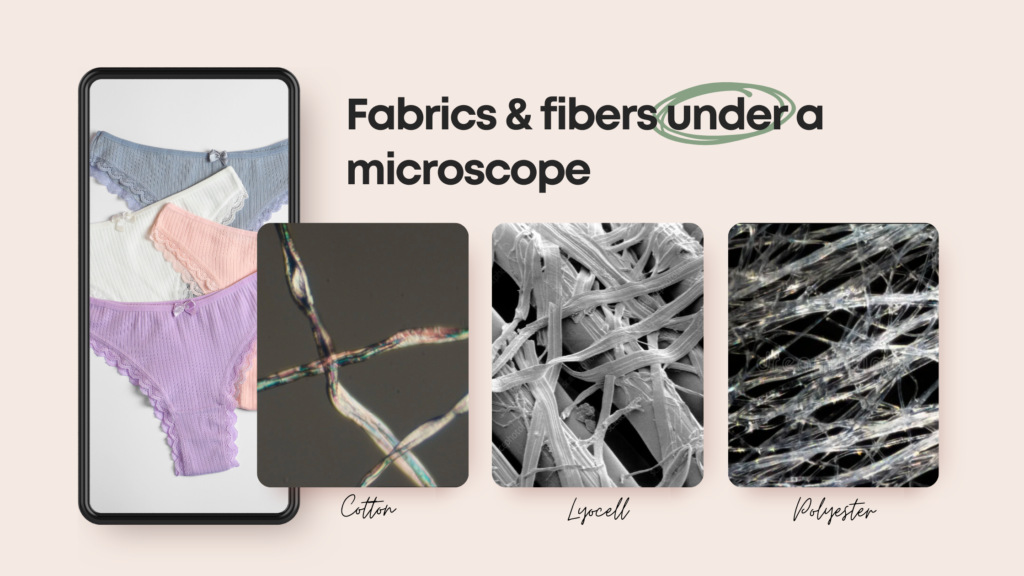
Different fibers have different surface textures at a microscopic level.
- Cotton fibers have a slightly twisted, ribbon-like structure, which can feel soft but also generate more friction with some skin types.
- Lyocell fibers are produced through a process that creates a smoother, more uniform surface, which is part of why TENCEL™ often feels noticeably silkier than cotton.
- Polyester and synthetic fibers are engineered and can vary widely when you look at their construction under a microscope.
For people with sensitive skin or conditions like lichen sclerosus or vulvar dermatitis, this friction difference can matter considerably in day-to-day comfort.
4. Fabric Construction Matters More Than Marketing
This is the one most blogs skip, and it’s arguably the most important: how a fabric is constructed often matters as much as the base fiber.
- GSM (grams per square meter): Lower GSM = lighter, more breathable. A 180 GSM bamboo fabric will feel heavier and trap more heat than a 130 GSM version.
- Elastane percentage: A small amount (typically 3–8%) improves fit and flexibility, but high percentages reduce breathability. Watch for underwear labeled “95% organic cotton, 5% elastane” vs blends with 20%+ synthetic.
- Liner/gusset design: The inner panel in direct contact with your vulva is what matters most. Some brands use a different fabric for the liner than the outer shell — a TENCEL™ outer with a cotton gusset, for example.
- Seam placement: Flat-lock seams reduce friction points. Seams running directly across sensitive tissue are a known irritant regardless of fabric.
Fiber matters. But construction matters just as much.
Cotton (Conventional)
Cotton is the default recommendation from most gynecologists, and for good reason. When people search for the best fabric for vaginal health, cotton is almost always the starting point.
Pros
- Breathable and well-tolerated: Decades of widespread use with minimal irritation reports. Cotton remains one of the most widely recommended breathable underwear fabrics.
- Widely available: Easier to find than almost any other fabric option, across every price point and style.
- Moderate moisture absorption: Absorbs moisture into the fiber (~8–9% moisture regain), keeping skin surface drier than synthetics.
- Affordable: No certification premium, no specialty sourcing. Reliable performance at an accessible price.
Cons
- Can hold moisture when wet: Thicker cotton constructions stay damp longer than lyocell or performance blends, which can be a problem during high-sweat activity.
- Blending is common and often unlabeled: many “cotton” underwear styles contain synthetic elastane or polyester in amounts that affect breathability, without obvious labeling.
- Pesticide-intensive farming: Conventional cotton is one of the most chemically treated crops in the world, with environmental costs that don’t show up on the price tag.
Is Cotton Good for Vaginal Health?
Yes — especially lightweight, breathable cotton that’s designed for everyday wear.
Breathable, soft, and well-tolerated by most skin types, it absorbs moisture and allows airflow. However, thick cotton or synthetic blends may reduce those benefits.
At a minimum, look for a 100% cotton gusset, even in underwear made from other fibers.
Cotton remains one of the safest baseline choices.
Organic Cotton vs Regular Cotton Underwear
Organic cotton performs the same as conventional cotton at the fiber level. The difference is in agricultural practice.
Organic certification (look for GOTS: Global Organic Textile Standard) means the cotton was grown without synthetic pesticides or GMO seeds, and processed without certain harmful dyes or finishing chemicals.
For vaginal health specifically, the practical benefit may be limited since residual pesticides in finished fabric are typically very low.
But for anyone with chemical sensitivities or contact dermatitis, certified organic cotton with cleaner dye processing is worth the premium. And from an environmental standpoint, it’s a meaningful vote with your wallet.
Related: Honest Subset Underwear Review: Organic Cotton Thong, Briefs & Boyshorts
Pros
- No synthetic pesticides: Conventional cotton is one of the most pesticide-intensive crops in the world. Organic farming eliminates synthetic pesticides and fertilizers entirely.
- Third-party certified: GOTS covers both farming and processing standards, creating a meaningful signal that the organic claim has been independently verified.
- Lower environmental toxin load: Less chemical runoff into soil and waterways, and generally safer conditions for farmers.
- Better for sensitive skin: Cleaner farming and processing standards make organic cotton a reasonable first swap if you experience contact dermatitis or unexplained irritation.
- More transparent supply chain: Organic certification requires traceability from farm to finished fabric. It’s a higher bar than most conventional cotton clears.
Cons
- Higher price point: Certification adds real cost, and it gets passed to you.
- “Organic” doesn’t mean fully clean: It covers farming, not finishing. Without OEKO-TEX certification, harsh dyes or chemicals may still be used in processing.
- Greenwashing is common: “Made with organic cotton” can legally mean only a fraction of the blend qualifies. Look for full-garment GOTS certification.
- Same fiber performance as conventional cotton: You’re paying for better farming practices, not better moisture management or breathability.
Bamboo (Viscose/Rayon from Bamboo)
Bamboo underwear is everywhere right now, and the marketing tends to lean hard into bamboo’s reputation as a sustainable, naturally antibacterial plant.
The truth is a little more complicated.
When people compare cotton vs bamboo underwear, they’re usually comparing cotton to bamboo viscose, a regenerated cellulose fiber produced through a chemical dissolution process and made from bamboo pulp.
The resulting fabric is soft and has strong moisture absorption (~11–13% moisture regain), which can make it feel comfortable during everyday wear. Any naturally occurring bamboo properties (like antimicrobial compounds) are largely destroyed in processing.
Pros
- Notably soft: The viscose process produces a fine, smooth fiber that tends to feel softer against skin than conventional cotton, often from the first wear.
- High moisture regain: At ~11–13%, bamboo viscose absorbs more moisture into the fiber than cotton, which can mean a drier feel against skin during everyday activity.
- Smooth and drapey: The fiber surface creates less friction than cotton, making it a comfortable option for sensitive skin or all-day wear.
- Widely available at accessible price points: Easier to find than TENCEL™ lyocell, with a broad range of styles across most mainstream and sustainable brands.
Cons
- The “bamboo” claim is misleading: What’s sold as bamboo fabric is almost always viscose rayon. Any naturally antimicrobial properties from the raw bamboo plant are largely destroyed in processing.
- Chemical-intensive production: The viscose process uses harsh solvents that can be polluting if not managed responsibly. It’s a meaningful environmental concern that the soft, natural-sounding marketing rarely mentions.
- Sustainability varies widely by brand: Unlike TENCEL™’s closed-loop process, standard viscose production has no guaranteed environmental standard. Transparency from the manufacturer matters a lot here.
Cotton vs Bamboo Underwear for Vaginal Health
From a performance standpoint, both fabrics can work well. Cotton vs bamboo underwear comparisons usually come down to three factors:
- Moisture absorption: Bamboo viscose absorbs slightly more moisture than cotton.
- Surface feel: Bamboo viscose tends to feel smoother.
- Sustainability transparency: Organic cotton generally has clearer certification standards.
Both can function well as breathable underwear fabrics, but the manufacturing process behind bamboo viscose varies widely by brand.
TENCEL™ Lyocell (Including Zinc-Infused Variations)
TENCEL™ is a brand name owned by Lenzing AG for their lyocell fiber. It’s worth understanding why lyocell is genuinely different from bamboo viscose, even though both are regenerated cellulose fibers.
If you’ve been researching TENCEL™ vs cotton underwear, the biggest difference is the manufacturing process and fiber structure.
Lyocell is produced using a closed-loop solvent system, meaning the chemicals used during production are captured and reused instead of released into the environment. This makes it one of the more credible options among modern sustainable underwear fabrics.
The raw material is often eucalyptus or beech wood, harvested from certified forests. This makes TENCEL™ one of the more credibly sustainable fabric options available at scale.
Fiber performance is also strong:
- Moisture regain ~11–12%
- Faster surface drying than cotton
- Very smooth fiber surface
- Strong when wet
These properties make lyocell one of the strongest candidates for the best fabric for vaginal health, particularly for people who experience friction or irritation.
Related: Huha Zinc Oxide Underwear Review: Better Than Organic Cotton?
Is TENCEL™ Good for Vaginal Health?
Yes. It combines high moisture absorption, a smooth low-friction fiber surface, and faster drying than cotton. The closed-loop production process also makes it one of the more sustainable mainstream fabric options. Zinc-infused versions add surface-level antimicrobial properties for odor reduction.
TENCEL™ vs Cotton Underwear
When comparing TENCEL vs cotton underwear, the biggest functional differences are:
- Moisture handling: Both absorb moisture, but lyocell often dries slightly faster.
- Surface smoothness: Lyocell fibers are more uniform, which reduces friction.
- Environmental production: TENCEL’s closed-loop system gives it an advantage among sustainable underwear fabrics.
Cotton is still the most widely recommended baseline option, but lyocell often wins on comfort for sensitive skin.
Zinc Oxide Gussets: What They Actually Do
Some brands — including those targeting vaginal health specifically — incorporate zinc oxide into the gusset or liner. Zinc oxide has a long history in medical and wound care textiles. At a surface level, it can reduce the growth of odor-causing bacteria and has mild antimicrobial properties.
Potential zinc infused underwear benefits include:
- Reduced odor buildup
- Mild antimicrobial surface properties
- Possible comfort improvement for sensitive skin
It is not a medical treatment, a cure or prevention for yeast infections, or a substitute for good hygiene or medical care.
The antimicrobial effect is surface-level and primarily relevant to odor management. If you’re prone to infections, the right conversation to have is with a clinician, not a fabric brand.
That said, for everyday wear, the combination of smooth lyocell fiber, good moisture absorption, and zinc oxide reducing odor-causing bacteria makes for a genuinely well-designed product, particularly for people who are sensitive or have chronic irritation concerns.
Synthetic Performance Fabrics (Polyester, Nylon, Spandex)
Synthetic fabrics get a bad reputation in vaginal health discussions — sometimes fairly, sometimes not. The nuance matters.
Polyester and nylon have very low moisture absorption (polyester <1%, nylon ~4%). They don’t hold moisture within the fiber; instead, moisture sits on the surface and evaporates.
For high-intensity, short-duration exercise, this surface-wicking behavior can actually work reasonably well. Sweat moves to the outer surface quickly and evaporates in a high-airflow environment.
The problem is extended wear. When you’re not actively generating enough heat to drive evaporation — sitting at a desk, running errands, traveling — low-absorption fabrics can create a persistently damp microclimate near the skin.
Add in the generally lower breathability of synthetic knits, and you get the conditions OB-GYNs warn about.
Pros
- Effective for high-intensity workouts: Surface-wicking moves sweat away from skin quickly in high-airflow conditions, which works well for short, intense exercise.
- Fast surface drying: Moisture doesn’t absorb into the fiber, so the fabric itself dries quickly after washing or sweating.
- Durable and shape-retaining: Synthetic fibers hold their elasticity longer than natural ones, meaning less stretch-out over time.
- Wide range of styles and price points: Synthetics dominate the mainstream underwear market, making them the most accessible option by volume.
Cons
- Very low moisture absorption: Polyester absorbs less than 1% of its weight in moisture; nylon ~4%. Neither pulls dampness away from skin the way cellulose fibers do.
- Creates a damp microclimate during everyday wear: Without high airflow to drive evaporation, moisture sits near the skin. This is the condition most OB-GYNs flag as problematic for vaginal health.
- Lower breathability: Synthetic knits restrict airflow more than natural fiber equivalents, compounding the moisture issue during sedentary or low-activity wear.
- Petroleum-based and difficult to recycle: Synthetics carry a significant environmental footprint at production and end of life, with microplastic shedding an additional concern during washing.
Is Moisture-Wicking Underwear Better?
For workouts? Possibly yes, for short durations. For all-day wear? That’s a hard no.
“Moisture-wicking” moves moisture away from skin but doesn’t absorb it. In low-airflow conditions, this can mean moisture sitting on the outer fabric surface rather than being pulled away from skin effectively.
Breathable absorption beats surface-wicking for everyday use.
This is one of the most misunderstood topics in underwear marketing. The debate around moisture wicking vs breathable underwear comes down to context.
For workouts: Moisture-wicking synthetics can perform well because sweat evaporates quickly in high-airflow environments.
For everyday wear: Breathable fabrics that absorb moisture into the fiber tend to be more comfortable.
That’s why many clinicians still recommend natural fibers for daily wear.
Underwear Fabric Comparison: Cotton vs Bamboo vs TENCEL™
If you’re comparing cotton vs bamboo underwear or TENCEL vs cotton underwear, the biggest differences come down to moisture absorption, breathability, and sustainability.
Here’s how the most common underwear fabrics compare:
| Fabric | Fiber Type | Moisture Regain | Breathability | Sustainability | Best For |
| Cotton | Natural cellulose | ~8–9% | Good | Moderate (conventional) | Everyday wear, reliable basics |
| Organic Cotton | Natural cellulose | ~8–9% | Good | High (GOTS certified) | Sensitive skin, eco-conscious everyday |
| Bamboo Viscose | Regenerated cellulose | ~11–13% | Good | Variable by brand | Soft comfort, moisture management |
| TENCEL™ Lyocell | Closed-loop lyocell | ~11–12% | Very good | High (closed-loop process) | Sensitive skin, active days, heat |
| TENCEL™ + Zinc | Lyocell + zinc oxide | ~11–12% | Very good | High | Odor reduction, sensitive skin |
| Polyester | Petroleum polymer | <1% | Low | Low | High-sweat workouts (short term) |
| Nylon | Petroleum polymer | ~4% | Low–moderate | Low | Light athletic use |
Choosing the Best Underwear Fabric
Best fabric for vaginal health and everyday wear
Organic cotton or TENCEL™ lyocell. Both absorb moisture well, breathe adequately for typical daily activity, and are gentle on skin. TENCEL™ has the edge for sensitive skin or warmer climates; organic cotton is easier to find and often more affordable.
Best workout underwear fabric
TENCEL™ or breathable performance blends with a moisture-absorbent gusset. If you’re doing intense training, a performance outer can work — but prioritize a natural fiber inner panel. Change out of workout underwear promptly.
Best sustainable underwear fabrics
Organic cotton (GOTS certified) or TENCEL™ from a Lenzing-verified brand. Avoid bamboo viscose from brands that don’t disclose their production process, as sustainability claims vary widely.
Best option for sensitive skin
Smooth lyocell (TENCEL™) is worth trying before anything else. The lower friction surface makes a real difference for many people. Zinc-infused options may help with odor if that’s a secondary concern.
When Fabric Alone Won’t Solve the Problem
This section exists because I think it’s important to be honest: underwear fabric is one variable in vaginal health, not a silver bullet.
If you’re dealing with recurrent infections, persistent irritation, or unusual discharge or odor, please talk to a doctor. No fabric, however well-designed, treats underlying medical conditions.
A few other factors that matter as much or more than fabric:
- Fit and tightness: Even the most breathable cotton underwear loses its advantage in a tight, restrictive cut. Airflow matters. Thongs, while fine for many people, keep fabric in closer contact with more tissue for longer periods — something worth noting if you’re prone to irritation.
- Hygiene habits: Washing new underwear before first wear, changing out of damp workout clothes promptly, and not sleeping in restrictive underwear are all worth more than any fiber property.
- Detergent and washing: Harsh detergents, fabric softeners, and dryer sheets leave residue that can irritate sensitive skin. Fragrance-free, gentle detergents are worth using on anything worn against your vulva.
- Overwashing and fiber degradation: Fabric properties change over time. Cotton softens but can pill; lyocell can become less smooth after many hot washes. Follow care instructions.
Related: The Best Non-Toxic Laundry Detergents for Sensitive Skin
Frequently Asked Questions
Is bamboo better than cotton for vaginal health?
Not necessarily. Bamboo viscose has slightly higher moisture regain than cotton (~11–13% vs ~8–9%), which can mean better moisture management in theory. But because most “bamboo” fabric is viscose rayon processed with chemicals, any naturally antimicrobial properties from raw bamboo are lost. For everyday comfort, both perform well — choose based on construction quality and brand transparency over the base fiber claim alone.
Is TENCEL™ breathable?
Yes. TENCEL™ lyocell has good air permeability, high moisture absorption, and a smooth surface that reduces friction. It’s often more breathable in practice than denser cotton fabrics, and faster-drying. For vaginal health and sensitive skin, it’s one of the strongest performers available in mainstream underwear.
Does zinc underwear prevent yeast infections?
No. Zinc oxide in gusset fabric has surface-level antimicrobial properties that may help reduce odor-causing bacteria — but it is not a medical treatment and does not prevent or treat yeast infections. If you’re experiencing recurrent yeast infections, speak with a gynecologist about underlying causes and treatment.
What fabric do gynecologists recommend?
Most OB-GYNs recommend breathable, moisture-absorbing fabrics for everyday wear, which means cotton and cotton-lined underwear are the most common recommendations. TENCEL™ lyocell has similar or better moisture management properties and is increasingly recognized in this context. The core principle: avoid prolonged dampness and non-breathable synthetic materials for all-day wear.
Is synthetic underwear bad for you?
Not inherently, but context matters. For short-duration athletic use, performance synthetics can be functional. For extended all-day wear, low moisture absorption and reduced breathability can create conditions (persistent dampness, heat) that are less favorable for vulvar health. If you’re prone to irritation or infections, minimizing synthetic fabrics for everyday wear is a reasonable precaution.
Final Verdict — It’s Not Just Natural vs Synthetic
The best fabric for vaginal health isn’t simply “natural good, synthetic bad.”
Fiber type matters.
But so do:
- Construction
- GSM (fabric weight)
- Gusset design
- Seam placement
- Sustainability practices
A thoughtfully constructed lyocell brief may outperform poorly constructed cotton underwear. And a well-certified organic cotton garment may be the best choice for someone prioritizing sustainable underwear fabrics.
The most useful framework is understanding what the fabric actually does:
Does it breathe?
Does it absorb moisture?
Does it reduce friction?
When those answers are yes, you’re much more likely to end up with underwear that supports both comfort and long-term health.

Leave a Reply