Last Updated on June 17, 2026 by Kasey Lynch
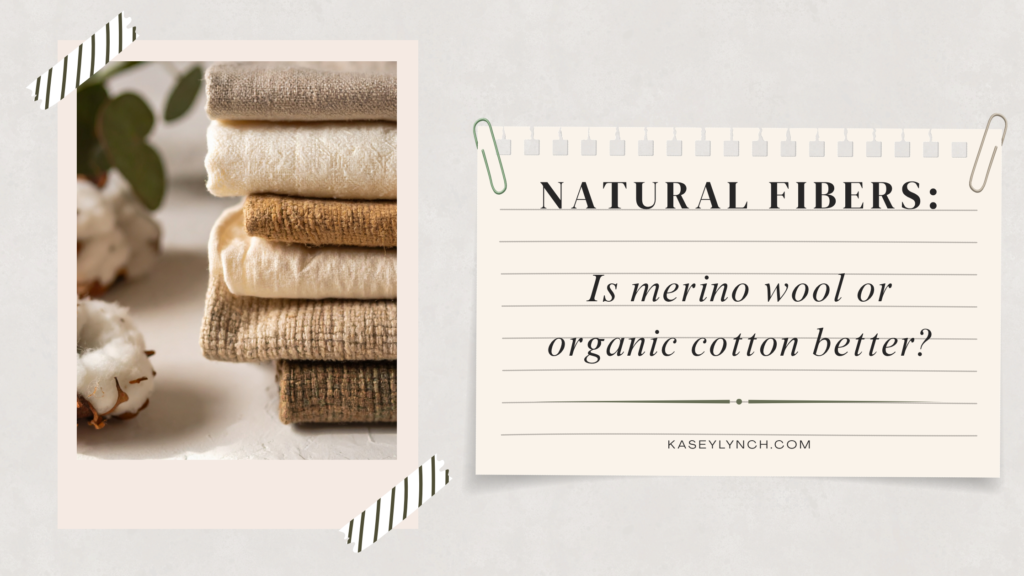
Both are natural. Both get recommended constantly. But they work very differently — and which one belongs in your wardrobe depends a lot on how you actually live.
Clothing is usually the last thing people address when they start reducing toxins in their life. Food, water, skincare, cleaning products — those tend to come first. But at some point it clicks: your skin is in contact with fabric for most of the day, every single day. And all night.
When you start researching natural fabrics, two names come up constantly: merino wool vs organic cotton. They’re often grouped together as the “safe” options — better than polyester, better than conventional cotton — but in practice, they’re not interchangeable. They perform differently, feel different, and suit different situations.
This is the full breakdown. Not just fiber science, but what actually matters if you’re trying to build a wardrobe that reduces your overall toxin exposure without making your laundry complicated or your bank account cry.
Table of Contents
- Why fabric matters in a low-tox lifestyle
- What makes merino wool different from regular wool
- Organic cotton: what "organic" actually means
- Head-to-head: merino wool vs organic cotton
- The underwear question — and my full testing series
- What about bedding and sleepwear?
- Certifications worth knowing before you buy
- Which one should you choose?
- Frequently asked questions
Why fabric matters in a low-tox lifestyle
Conventional clothing is more chemically complex than most people realize. Polyester and nylon are petroleum-based plastics spun into fiber. Acrylic is essentially the same thing. These synthetic fabrics are commonly treated with chemical finishes — wrinkle resistance, moisture-wicking treatments, dyes, antimicrobial coatings — that don’t always appear on the label and don’t always wash out.
Even “natural” conventional cotton has a significant chemical footprint. Cotton is one of the most heavily pesticide-treated crops in the world. Those pesticides don’t stay on the farm — they persist through processing, and traces can end up in the finished fabric sitting against your skin.
The skin is absorbent, especially in areas where fabric is in close, constant contact — think underwear, base layers, and sleepwear. This is why those categories, in particular, are worth paying attention to when you’re trying to reduce exposure.
Switching to natural fibers — and specifically to certified organic versions where possible — isn’t about achieving perfection. It’s about reducing baseline exposure over time. And it has practical upsides too: natural fabrics tend to breathe better, feel better on sensitive skin, and wear more gracefully with age.
Related: A Clear Guide to the Best Underwear Fabrics (Cotton, Bamboo & TENCEL™ Compared)
What makes merino wool different from regular wool
Not all wool is created equal. Regular wool — the kind in chunky knit sweaters — can be scratchy and uncomfortable against bare skin. Merino comes from a specific breed of sheep originally from Spain, now farmed primarily in Australia and New Zealand, and it’s fundamentally different in texture.
Merino fibers are extremely fine — typically between 17 and 22 microns in diameter. Standard wool can be 30 microns or more. That fineness is what makes merino soft enough to wear directly against skin without itching.
But the real reason merino gets so much attention in low-tox and outdoor circles isn’t just softness — it’s performance. Merino is genuinely impressive from a fiber science standpoint:
- It can absorb a significant amount of moisture vapor before it feels wet, which means it stays comfortable longer during activity
- It actively wicks moisture away from skin and releases it into the air, rather than trapping it
- It regulates temperature in both directions — keeping you warm when it’s cold, and surprisingly comfortable when it’s warm
- It resists odor naturally, so it can be worn multiple times before needing a wash
- It’s biodegradable at end of life
For a low-tox lifestyle, the washing frequency point is worth lingering on. Every time you wash clothing, you’re using detergent. If you’re trying to reduce chemical exposure, washing less — with the same garment staying fresh — is a genuine benefit, not just a convenience.
That said, merino does have real drawbacks. It’s significantly more expensive than cotton. It requires more careful washing (cold, gentle cycle — or hand wash). And some people still find even fine merino slightly scratchy, especially in warmer weather or in tight-fitting styles.
Organic cotton: what “organic” actually means
The word “organic” gets used loosely in fashion, which is frustrating. When it comes to cotton specifically, it matters a lot.
Conventional cotton uses some of the highest levels of pesticide application of any crop. Organic cotton is grown without synthetic pesticides or fertilizers. That’s meaningful both for the farming environment and for what ends up in the final fabric — though it’s worth noting that the processing stages (dyeing, finishing, bleaching) can introduce chemicals even after organic farming.
This is why certifications exist, and why GOTS (Global Organic Textile Standard) is considered the gold standard. GOTS covers not just how the cotton was grown, but how it was processed — including restrictions on the dyes and chemicals used throughout the supply chain. A GOTS label means the fabric is organic all the way through, not just at the farm gate.
From a feel and function standpoint, organic cotton and conventional cotton aren’t dramatically different to wear. The experience is familiar: soft, breathable, and comfortable for everyday use. It’s easy to integrate into daily life, easy to launder, and generally gentle on sensitive skin.
Where it differs from merino is in performance. Cotton absorbs moisture and holds onto it — great for a towel, less ideal during physical activity or in variable weather. It doesn’t regulate temperature actively. And it needs to be washed more frequently to stay fresh, since it doesn’t have the same natural odor resistance as wool.
Related: Honest Subset Underwear Review: Organic Cotton Thong, Briefs & Boyshorts
Head-to-head: merino wool vs organic cotton
| Category | Merino Wool | Organic Cotton |
| Temperature regulation | Active — adapts to warm and cold conditions | Passive — breathable but doesn’t adapt |
| Moisture handling | Wicks moisture away from skin, releases it into air | Absorbs moisture and holds it |
| Odor resistance | Naturally odor-resistant; can be worn 2–3+ times between washes | Needs regular washing to stay fresh |
| Skin feel | Soft in fine grades; some people find it slightly itchy | Very consistent softness; rarely irritating |
| Sensitive skin | Good in fine grades (under 18.5 microns); check grade before buying | Excellent; generally the safer default |
| Laundry requirements | Cold, gentle; less frequent washing needed | Machine washable; washes more frequently |
| Cost | Higher upfront cost; cost-per-wear improves with durability | More accessible price points |
| Best use cases | Base layers, active use, travel, layering | Everyday basics, underwear, bedding, casual wear |
| Certification to look for | RWS (Responsible Wool Standard), mulesing-free sourcing | GOTS (Global Organic Textile Standard), OEKO-TEX |
| End of life | Biodegradable | Biodegradable |
The underwear question — and my full testing series
If there’s one category where fabric choice matters most from a low-tox perspective, it’s underwear. It’s in constant contact with some of the most absorptive and sensitive skin on your body. It’s worn all day. And yet most conventional underwear is made from synthetic blends — polyester, nylon, spandex — often with added finishes.
Switching to natural fiber underwear was one of the first fabric swaps I made, and it led to what became an extended testing project.
I’ve tested 20+ pairs of cotton and organic cotton underwear — different brands, cuts, price points, and certifications — so you don’t have to spend months and a lot of money figuring it out yourself.
The full series is on TikTok: everything from first impressions to how they actually hold up after dozens of washes.
Watch the series →The short version of what testing 20+ pairs taught me: not all organic cotton underwear is created equal. GOTS certification matters more than the word “organic” on a label, fabric weight affects durability significantly, and fit can vary enormously between brands even in the same size.
For underwear specifically, organic cotton tends to be the more practical choice over merino for most people — it’s more affordable, machine washable, and widely available. Merino underwear exists and has genuine advantages (odor resistance is a real benefit here), but at a price point that most people aren’t going to replicate across their whole drawer.
What about bedding and sleepwear?
Bedding is one of the highest-exposure categories most people overlook. You’re in contact with your sheets for 7–9 hours a night, with minimal clothing between your skin and the fabric.
If your sheets are made from conventional cotton treated with wrinkle-resistant or easy-care finishes (which often involve formaldehyde-based compounds), that’s a long exposure window.
Organic cotton is the practical choice for most people’s bedding — sheets, pillowcases, duvet covers. It’s comfortable, breathable, and the closest to what most people already use. The switch is low-friction. Just look for GOTS certification rather than just “organic” on the label, since that covers processing as well as growing.
Merino wool is less commonly used for bedding in the traditional sense, though merino wool duvets do exist and have enthusiasts. For sleepwear — pajamas and nightwear — merino’s temperature regulation can be genuinely useful if you tend to run warm or cool, or if you live somewhere with variable nighttime temperatures. It’s a niche use case, but it’s worth knowing the option exists.
Certifications worth knowing before you buy
Even within natural fabrics, the word “natural” on a label means almost nothing. This is where certifications do actual work.
For organic cotton
GOTS (Global Organic Textile Standard) is the most comprehensive. It covers the entire supply chain — from the farm to the finished product — including restrictions on dyes, bleaches, and chemical finishes used in processing. A GOTS label means the organic claims have been verified at every stage, not just at the cotton farm.
OEKO-TEX Standard 100 is a different kind of certification — it tests the finished product for harmful substances rather than certifying the process. An OEKO-TEX label means the fabric has been tested and shown to be free from a defined list of harmful chemicals. Both are meaningful; GOTS covers how it was made, OEKO-TEX covers what’s in it.
For merino wool
RWS (Responsible Wool Standard) covers animal welfare and land management practices. If animal welfare is a concern for you, this is the certification to look for. Some brands also specifically advertise mulesing-free sourcing — mulesing is a controversial farming practice, and many consumers prefer to avoid it.
Some merino wool also carries GOTS or OEKO-TEX certification, which covers the processing side of things — dyes, finishes, and chemical treatments applied after the wool is shorn.
A note on blends
Blended fabrics — organic cotton/spandex, merino/nylon, and so on — are where things get murkier from a low-tox perspective. Small percentages of synthetics are common in clothing that needs stretch, and these can affect how the fabric performs, how it biodegrades, and what certifications apply. It’s worth reading blend percentages carefully rather than assuming a “mostly organic cotton” garment is fully low-tox.
Which one should you choose?
The honest answer is that most people who care about low-tox living end up using both — just for different purposes. There isn’t a single fabric that wins across every category. Here’s a practical way to think about it:
Choose merino wool for
- Base layers for hiking or outdoor activity
- Travel — fewer washes, less luggage
- Layering in variable conditions
- Anyone who runs warm and wants temperature regulation
- Reducing how often you need to do laundry
Choose organic cotton for
- Underwear and everyday basics
- Bedding and sleepwear
- Sensitive or reactive skin
- High-wash-frequency items like workout tees
- Anyone building a low-tox wardrobe on a budget
The bigger shift — which matters more than choosing between these two — is moving away from synthetic fabrics entirely. Replacing polyester basics with organic cotton, or switching your athletic base layer from a synthetic blend to merino, is where the most meaningful reduction in exposure happens.
From there, it’s about adding the right fiber in the right context, rather than trying to make one material do everything.
Frequently asked questions
Is merino wool actually better than organic cotton?
Neither is universally better — they solve different problems. Merino wool outperforms organic cotton in temperature regulation, moisture management, and odor resistance. Organic cotton is gentler on sensitive skin, easier to care for, more affordable, and better suited to everyday basics like underwear and bedding. Most people benefit from having both in their wardrobe.
Is organic cotton underwear actually better for you?
For most people, yes — it reduces exposure to the pesticide residues, chemical finishes, and synthetic dyes found in conventional cotton and synthetic underwear. Look for GOTS-certified organic cotton, which covers processing as well as growing. If you want to go deeper, my TikTok series “I’m trying organic cotton underwear so you don’t have to” covers 20+ pairs tested across brands and price points.
Can merino wool be worn in summer?
Yes — lightweight merino (typically under 150gsm) works well in warmer conditions. Its temperature regulation and moisture management can actually keep you cooler than cotton in humid heat. It’s counterintuitive but genuinely effective, which is why it’s popular for summer travel and hiking.
What does GOTS certified mean for cotton clothing?
GOTS (Global Organic Textile Standard) is the most comprehensive organic textile certification available. It covers the full supply chain — from the organic cotton farm through spinning, weaving, dyeing, and finishing — with strict limits on chemical inputs at every stage. It’s meaningfully different from simply seeing “organic cotton” on a label, which only refers to how the raw fiber was grown.
Is merino wool low-tox?
Merino wool is a natural fiber and inherently free from the microplastic concerns associated with synthetic fabrics. Whether a specific merino garment is truly low-tox depends on how the wool was processed — dyes, chemical finishes, and treatments applied after shearing can introduce chemicals. Look for RWS certification for ethical sourcing and OEKO-TEX Standard 100 certification for chemical safety in the finished product.
What fabric is best for sensitive skin?
Organic cotton is generally the safest starting point for sensitive or reactive skin — it’s soft, breathable, rarely irritating, and widely available in certified options. Fine merino wool (under 18.5 microns) can also work well for sensitive skin, and has the advantage of moisture management. Avoid synthetic fabrics, synthetic blends, and anything labeled wrinkle-resistant or easy-care, as these finishes are common irritants.
Choosing better takes time
Building a lower-tox wardrobe doesn’t require replacing everything at once. Starting with the highest-exposure categories — underwear, bedding, and base layers — and deciding between merino wool vs organic cotton depending on the use case is a practical way to reduce your overall exposure without overhauling your closet overnight. The goal is gradual replacement with things that actually work for your life.