Last Updated on July 12, 2026 by Kasey Lynch
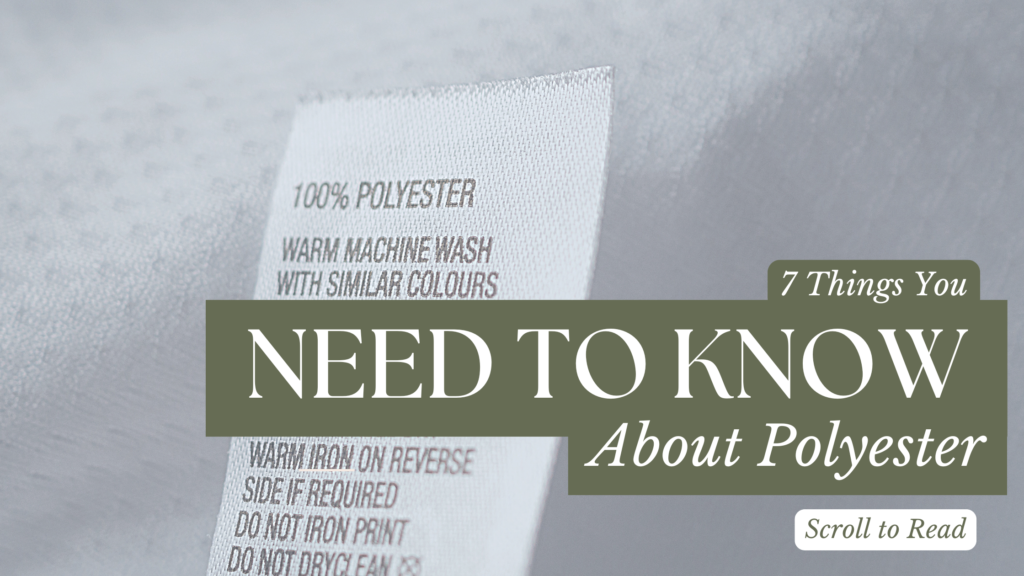
I didn’t set out to become the person who reads fabric labels on every single solitary item she considers purchasing.
But once you start noticing what’s actually touching your skin all day, you can’t stop — and polyester is the common thread behind a lot of habits we’ve all quietly accepted as “normal.”
Itchy skin after a long day in a bra. A “cozy” sweater that somehow doesn’t keep you warm.
Ever notice your gym towel and workout gear always need that “extra fresh” fragrance-bomb detergent? That’s not you being picky — it’s synthetic fabric trapping bacteria so well that regular detergent can’t keep up, and since that stuff sits right against your skin, it goes from fine to funky fast.
None of that is random. It’s mostly one material, showing up everywhere, impacting your body and your home.
This is the clear, honest breakdown of what polyester actually is, why it behaves the way it does, and the specific ways it shows up in your daily life, whether you’ve clocked it or not.
Table of Contents
What is polyester, actually?
Polyester is a synthetic fiber made from petroleum, specifically a plastic called PET (polyethylene terephthalate), the same base material used in plastic water bottles.
It’s created in a lab, not grown in a field. It’s cheap to produce, holds color well, resists wrinkling, and can be a beneficial material for certain jobs. Structurally speaking, it’s still just plastic, and plastic behaves like plastic whether it’s in the shape of a bottle or a bra.
Before you jump to conclusions and assume everything in your house needs to be swapped out, polyester isn’t going anywhere. It’s not always toxic for most people when chosen intentionally.
But it is worth understanding why it does what it does, so you can make an informed call about where you actually want it in your life.
7 Things You Should Know About Polyester
1. Your skin isn’t supposed to be itchy after you take your bra off
If your skin is irritated, red, or itchy by the end of the day — and it’s always the bra, always the underwear — that’s not automatically “sensitive skin.” Synthetic fabrics like polyester don’t breathe the way natural fibers do, so heat, sweat, and friction get trapped against skin that’s already under pressure from elastic and seams. Over a full day, that combination is enough to trigger irritation even in people who don’t consider themselves reactive.
Natural fibers, especially organic cotton, allow airflow and pull moisture away from skin instead of holding it there. It’s the difference between skin that gets to breathe and skin that’s sitting in its own humid climate for eight-plus hours.
How do you feel after spending a day outside in the humidity? That’s what’s happening but on a smaller scale.
Shop bras, bralettes, and sports bras with high percentages of natural fibers >>>
2. Downstairs odor isn’t a hygiene problem — it’s a fabric problem
Sweat itself doesn’t actually smell. It’s odorless.
Sweat itself is essentially odorless — it’s mostly just water and salt. The smell shows up when bacteria that live on your skin get a hold of that sweat (and the oils in it) and start breaking it down. That breakdown process is what produces the actual smelly scent.
Synthetic fibers make this worse in two ways:
- Their surface has a rougher, more microscopic texture that gives bacteria more places to grip and hide
- The fibers themselves are good at holding onto the oily byproducts those bacteria leave behind.
So you’re not just dealing with sweat — you’re dealing with a fabric that’s actively hanging onto the bacteria and the smell they produce, wash after wash. Let’s break that down a little further.
Polyester fibers are hydrophobic (they repel water), but they readily bind to the fatty, oil-based compounds available on your skin through sweat. Their microscopic surface structure gives bacteria tiny grooves to hide in — grooves that a regular wash cycle often can’t fully reach.
That’s why a “clean” synthetic garment can still smell the moment you sweat in it again: the bacteria weren’t removed for good; they were lying dormant.
Natural fibers don’t offer bacteria the same real estate, so odor doesn’t build up in the fabric itself the same way. That’s why people love wearing linen in the dead heat of summer.
I’ve scored over a dozen brands on a 100-point system (gusset coverage, seams, fabric quality, all of it). See who’s earning the top spots >>>
3. Ever put on a massive, chunky sweater and somehow you’re still cold?
Polyester, nylon, and rayon are plastic, and plastic doesn’t regulate temperature. It doesn’t have the fiber structure to trap warm air near your body or wick away the moisture, leaving you feeling cold and clammy.
Wool, cotton, and linen all have a more complex, often hollow fiber structure that traps air for insulation and manages moisture at the same time, which is why they can keep you warm and comfortable rather than just bulky.
If you’re layering up and still cold, you don’t need a bigger sweater. You need one made of natural fibers.
Shop my favorite natural fiber sweaters here >>>
4. When a towel just pushes water around the counter instead of absorbing it
That’s polyester, or a poly-microfiber blend, doing exactly what plastic does: repelling water instead of absorbing it.
It’s the same hydrophobic property that makes polyester useful for rain jackets — just in completely the wrong context for a kitchen towel. (I’m not sure about you, but I’m a big fan of a quality rain jacket.)
Cotton is naturally absorbent because of its fiber structure, which is why a cotton towel soaks up a spill on contact instead of shoving it toward the edge of the counter, ready to expand the mess.
5. Sweat through a shirt in five minutes flat, even when it’s not that hot out?
Take comfort in the fact that you’re probably not overheating more than usual. Your shirt is just trapping what your body is trying to release to assist in temperature regulation. Synthetic fabrics don’t breathe or wick moisture the way natural fibers do, so sweat sits against your skin instead of evaporating.
Ironically, a lot of “moisture-wicking” performance fabric is polyester engineered to move sweat to the surface of the fabric rather than actually absorbing and releasing it. This adjustment helps with that clammy feeling short-term, but does nothing for the odor-trapping problem in #2 on this list.
Related: 16 Natural Fiber Clothing Brands That Are Actually Worth Your Closet Space
6. That static cling every time you pull off a sweater
Also polyester. Static builds up when two materials rub together and exchange electrons, and synthetic fibers are especially prone to it because they don’t hold moisture — moisture in fabric actually helps dissipate static charge.
Natural fibers retain a small amount of ambient moisture even when they feel dry, which is part of why you don’t usually walk out of a fitting room with your hair standing on end after trying on a cotton sweater versus a plastic one.
7. If a “moisture-wicking” workout gear smells again almost instantly
You’re working hard, but that’s polyester holding onto bacteria faster as you generate more sweat and heat during exercise. It’s a big part of why “technical” athletic wear so often develops a smell that regular detergent can’t fully remove.
Related: Non-Toxic Underwear Brands Review: I Tested 20+ Pairs and Scored Every Single One
Does polyester keep you warm?
Not on its own. Polyester has no meaningful insulating structure, meaning it doesn’t trap air the way wool does, and it doesn’t manage moisture the way cotton or linen does.
It can be engineered into fleece and other insulating blends that perform reasonably well in technical gear, but for everyday clothing, a “warm-looking” polyester sweater is often why you still feel cold at the office or running errands at the grocery store.
Is polyester bad for you?
For most people, wearing polyester occasionally isn’t dangerous. It’s not going to make you sick. But it can be the root cause of discomfort — trapping heat, sweat, and odor against skin that’s not built to sit in that environment all day, especially in high-contact areas like bras, underwear, and socks.
Some polyester garments are also treated with finishing chemicals (not the polyester fiber itself) that can trigger irritation in people with sensitive skin. If you’ve noticed a pattern of irritation, checking whether the garment is polyester — and what it’s been treated with — is a reasonable place to start checking if your clothes are the culprit.
Ready to make the swap? I already did some digging for you. Here’s my collection of natural fiber brands that actually deliver >>>
What to wear instead
You don’t need to overhaul your entire closet overnight. Start with the places polyester touches your body the most and the longest:
- Bras — the highest-stakes category for prolonged skin contact. Organic cotton is the most breathable, widely available option, and it’s the first swap that makes a noticeable difference by the end of the day.
- Underwear — same logic, even higher stakes. This is the one place synthetic fabric does the most damage in terms of irritation and odor.
- Socks — natural fiber socks (cotton or wool blends) do more for foot odor than any powder or spray you’ll buy after the fact.
- Scrubs — if you’re on your feet in scrubs for a 12-hour shift, that’s about as high-contact and long-duration as fabric exposure gets. Cotton breathes where synthetic scrubs trap heat and sweat all day.
- Elevated essentials — your go-to, everyday closet staples deserve the same scrutiny as anything else touching your skin daily.
- Loungewear — this is what you’re in for hours around the house, unwinding, sleeping in, existing in. If anything deserves to be natural fiber, it’s this.
- Activewear — the highest-sweat category there is, which makes it the worst place for synthetic fabric to trap bacteria and odor.
Where polyester actually makes sense
None of this means plastic is automatically the enemy. It means plastic is the wrong tool for jobs that involve your skin, for hours, every single day. That distinction matters, because exposure compounds. A few hours a day, every day, for years, adds up to something very different than an item you touch a handful of times a year.
Where polyester genuinely earns its spot is anything sitting outside, in the sun, for the long haul, with little or no skin contact. UV exposure breaks down natural fibers over time — they fade, weaken, and degrade faster than synthetic ones do. Polyester’s plastic structure is much more UV-resistant, so it holds up where a natural fiber would wear out in a season or two.
Outdoor cushions and umbrellas, patio furniture covers, awnings, tarps, boat covers, outdoor rugs — this is polyester doing what it’s actually good at, and the tradeoff makes sense. You’re not wearing it for eight hours a day; you’re asking it to survive weather and sun without falling apart, and it does that job better than almost anything natural.
The same logic applies to a handful of other categories: things like luggage, backpacks, tents, and gear that need to be durable and weather-resistant more than they need to be breathable against skin. The common thread is low, occasional skin contact and a job that plays to plastic’s actual strengths — durability and resistance — instead of asking it to do something it was never built for.
My honest theory
It’s not that polyester is bad and natural fiber is good, full stop. It comes down to what the fabric is actually being asked to do. Something you’re wearing for hours, every day — bras, underwear, sheets, socks, towels — that needs to be a natural fiber. But something baking in the sun all day, whose whole job is just to hold up? That’s where polyester shines every time.
But here’s the thing nobody selling you the “solution” wants pointed out: a huge portion of what we buy to fix the itch, smell, static, and sweat that exists is all because plastic is sitting between us and our clothes. Like most things, odor sprays, static guards, special detergents, and moisture-wicking underlayers are treating symptoms of a fabric problem, on repeat, forever.
No problem? No product to keep selling you.
Natural fibers aren’t magic! You’ll still sweat, and natural odor is a normal, healthy thing bodies do. But fabric that works with your skin instead of trapping everything against it means you’re not stuck buying a new “cure” every time the old one stops working.
Frequently Asked Questions
Is polyester bad for your skin?
It’s not toxic for most people, but it doesn’t breathe, so it traps heat, sweat, and bacteria against skin, causing irritation, breakouts, or itchiness, especially in high-contact areas like bras and underwear.
Why do my clothes smell even after washing?
Synthetic fibers like polyester bind to the oily, bacteria-produced compounds that cause odor, and their microscopic fiber structure lets bacteria hide in spots a regular wash cycle can’t fully reach. The bacteria go dormant rather than disappear, and reactivate the next time you sweat, meaning the stench returns quickly.
Does polyester keep you warm?
No. Polyester lacks the fiber structure that traps air and manages moisture the way wool, cotton, and linen do, so it doesn’t insulate the way people expect when putting on a “warm” sweater.
Why does polyester cause static cling?
Because it holds almost no moisture, and moisture is what normally helps dissipate the static charge that builds up when fabric rubs against itself or your skin.
Is polyester or cotton better for sensitive skin?
Cotton, particularly organic cotton, is generally better tolerated because it’s breathable and doesn’t trap heat and moisture the way polyester does. Some reactions attributed to polyester are actually caused by dyes or finishing chemicals rather than the fiber itself.
The bottom line
None of this requires a dramatic closet overhaul or swearing off plastic entirely. It just requires noticing where it’s actually showing up in your life — and asking whether that spot is a good fit for it. A patio cushion baking in the sun all summer? Great job for polyester. A bra you wear for ten hours a day, a towel you dry your skin with, the sheets you sleep in? Not so much.
Once you start reading labels with that lens — high contact vs. low contact, daily vs. occasional — a lot of the itching, smelling, and static you’ve been quietly living with starts making sense. And the fix usually isn’t another product. It’s just choosing the fiber that was built for the job in the first place.